



While your competitors are betting everything on tomorrow's breakthrough, their core business is quietly crumbling today. The innovation graveyard is littered with companies that forgot a simple truth: you need to run three races simultaneously - and win them all.
Many business leaders might feel overwhelmed by the increasing complexity of today’s business world. Innovation challenges are a reality that organizations must address as they navigate uncertainty and volatility. Growing uncertainty and volatility can be perceived as a threat to business stability, but on the upside, the rapid pace of technological change and disruptive trends can create the perfect conditions for innovation and open up new growth opportunities.
However, organizations need to be able to prioritize and focus on the right innovation investments. This article examines the Three Horizons Model, an innovation portfolio planning model recommended by Gartner® to balance different innovation objectives.
The importance of innovation portfolio management to focus innovation efforts
The broad spectrum of disruptive change across industries highlights the need for a dedicated focus on innovation to enable business continuity and sustainability. Business leaders are encouraged to strategically examine their organizations and identify innovation portfolios to focus their innovation efforts. Effective portfolio management helps organizations structure and oversee their innovation efforts, ensuring a balanced approach to risk, resources, and strategic objectives.
Nurturing an innovation orientation within your organization can improve your current offering and develop new business opportunities. According to Gartner, organizations can prioritize innovation efforts along seven dimensions to enable the development and optimization of their innovation portfolios. Strategic alignment and resource allocation are crucial in ensuring that innovation initiatives support business objectives and maximize value creation.
The Gartner report “Define Innovation Along 7 Dimensions to Prioritize Your Innovation Efforts” underpins the premise that innovation is executing new ideas that create value. It equips business leaders and innovation champions with the inside track on leveraging insights to build a solid innovation portfolio.
Incorporating innovation initiatives and categorizing project types are essential elements of a comprehensive innovation strategy, enabling organizations to manage and execute innovation effectively.
Unlock innovation with the Three Horizons Model
According to Gartner, identifying innovation target portfolios can be supported by the Three Horizons Model, which has proven helpful in highlighting the need for a portfolio approach to innovation as outlined in the report.
A portfolio framework and portfolio-based approach are essential for managing innovation effectively. The Three Horizons Model provides a structured process and approach for managing different project types and risk profiles within an innovation pipeline. By categorizing projects - such as early-stage ideas, new projects, ongoing projects, and specific projects - across the three horizons, organizations can align their innovation ambition and risk tolerance with company goals, strategic objectives, and business objectives.
This enables innovation managers, innovation teams, and innovation departments to allocate resources efficiently, ensure enough resources for promising opportunities, and drive growth while maintaining a competitive edge.
Initially developed by McKinsey, the Three Horizons Model (Exhibit 1) is a tried and tested method of exploring innovation across various organizational scenarios, helping business leaders, senior management, and key stakeholders prioritize focus and resources across three defined horizons. Project management and resource management are key parts of balancing innovation ambition and risk tolerance, as each horizon contains different types of innovation, risk profiles, and risk levels that require careful oversight and decision-making.
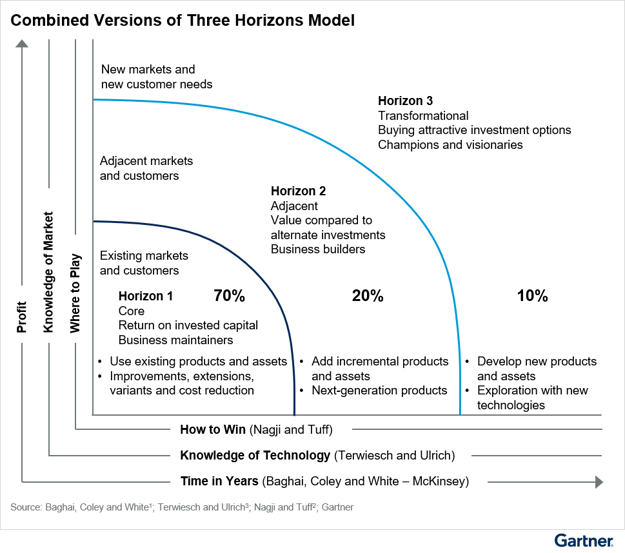
Exhibit 1: The combined version of the three horizons model
According to Gartner, the most commonly cited portfolio balance across the Three Horizons is 70% in Horizon 1, 20% in Horizon 2, and 10% in Horizon 3.
We believe the first horizon helps you focus on your organization’s core business and guides you to elicit opportunities for innovation and potential growth in new markets or to identify product diversification opportunities. Horizon 1 typically includes ongoing projects and existing products, where project management and resource management are focused on incremental improvements and operational efficiency.
The second horizon extends the boundaries of innovation by examining options that hold inherent value in alternative markets, such as adding or diversifying product offerings and next-generation product iterations. Here, innovation managers and innovation teams evaluate new projects and early-stage ideas based on their innovation potential, business models, and risk profiles, ensuring alignment with strategic objectives and the overall innovation ambition matrix.
Whereas the third horizon is the domain of transformative innovation, where new products and technologies form the basis of breaking new ground. This includes transformational projects, radical innovation, and transformational initiatives, which require a higher risk tolerance and a different approach to project management and resource allocation.
Balancing the innovation portfolio across all three horizons is a key part of managing innovation. It ensures enough resources are allocated to each horizon in line with company goals, strategic objectives, and business objectives, and supports financial success by focusing on promising opportunities that drive growth. The innovation ambition matrix is a valuable tool for aligning innovation ambition, risk profiles, and resource allocation, helping organizations manage innovation pipelines and achieve a sustainable competitive edge.
How ITONICS supports innovation prioritization
Innovation is exciting, but the innovation process can be challenging with many variables at play. The ITONICS Innovation OS aims to help you manage the complexity of innovation by enabling the thorough exploration of market opportunities so you can focus on prioritizing the right innovation opportunities. It supports innovation portfolio management and enables informed decision-making for portfolio managers by providing a structured approach to align innovation initiatives with strategic goals.
The ITONICS Radar and Insights tools enable you to confidently scan the environment for emerging trends and potential drivers of change, helping you to gather data for anticipated future scenarios. The ITONICS Portfolio tool has various features that allow you to balance your innovation efforts. Innovation portfolio tools like ITONICS Portfolio help track and manage innovation activities, supporting informed decisions and empowering the portfolio manager to optimize resource allocation and project prioritization. The ability to continually analyze and monitor your innovation programs will ensure that the execution of your strategic goals is on track.
Disclaimer
GARTNER is a registered trademark and service mark of Gartner, Inc. and/or its affiliates in the U.S. and internationally and is used herein with permission. All rights reserved.
Gartner, Define Innovation Along 7 Dimensions to Prioritize Your Innovation Efforts, Jackie Fenn, Peter Skyttegaard, Refreshed 6 May 2022, Published 3 December 2020.